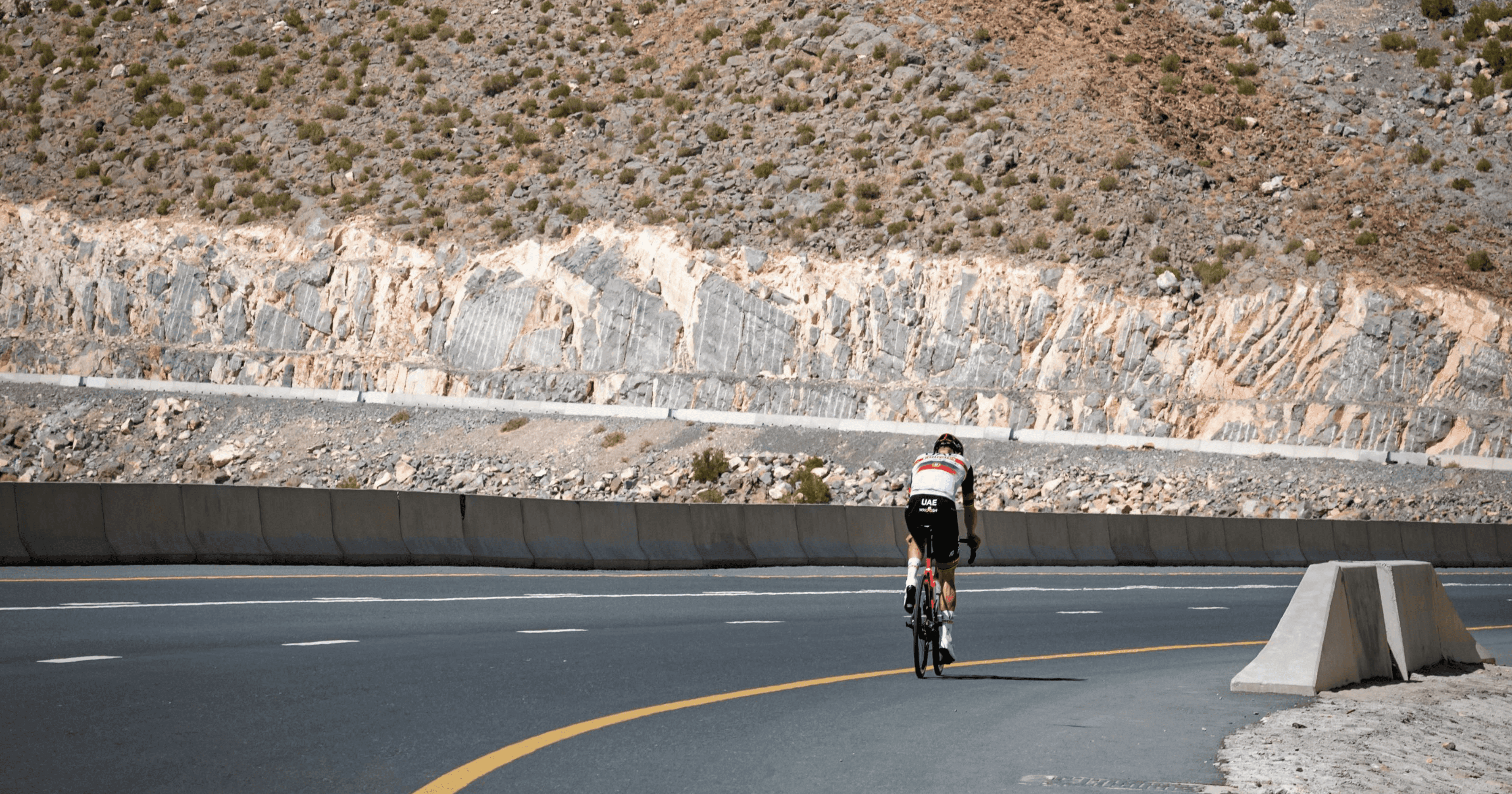
There's something deeply satisfying about a solo ride. No waiting around, no compromising on pace or route, just you, your bike, and the road ahead. But riding alone also means that if something goes wrong — a crash, a mechanical, a close pass from a distracted driver — there's no one there to help.
The good news: with the right habits and the right cycling safety tools, solo riding can be just as safe as group riding. Here's everything you need to know — before, during, and if things go wrong.
Before You Leave: The Habits That Actually Matter
Tell Someone. Every Single Time.
It sounds obvious. Most cyclists skip it anyway — especially on familiar routes, especially when they're "just going for a quick one."
Here's why it matters more than people think: between 52% and 85% of cyclist injuries result from single-bicycle crashes — no car, no other vehicle involved. A pothole hidden by a shadow, a patch of gravel on a bend, a moment of tired inattention — and suddenly you're on the ground, on a road where no one knows to look for you.
Picture this: it's 7pm, you went out for a 90-minute ride after work, and you haven't come back. Your partner assumes you went further than planned. By the time anyone starts to worry, it's dark.
Before every solo ride, share three things with someone you trust:
- Your planned route, or at least the general area
- Your expected return time
- What to do if they haven't heard from you by a specific time
A quick message takes 20 seconds. It costs nothing. And for the people who care about you, it's the difference between an anxious evening and a peaceful one.
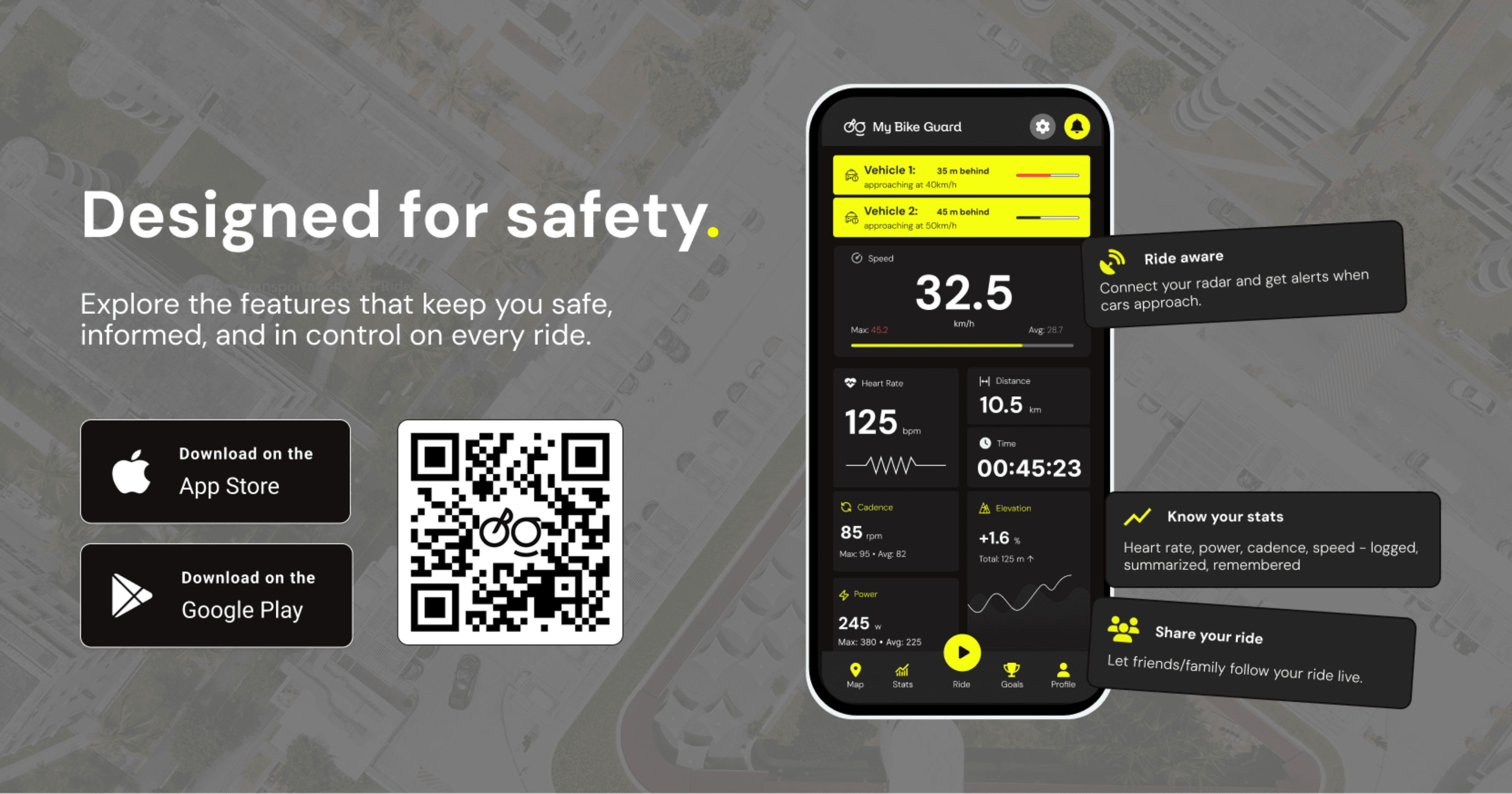
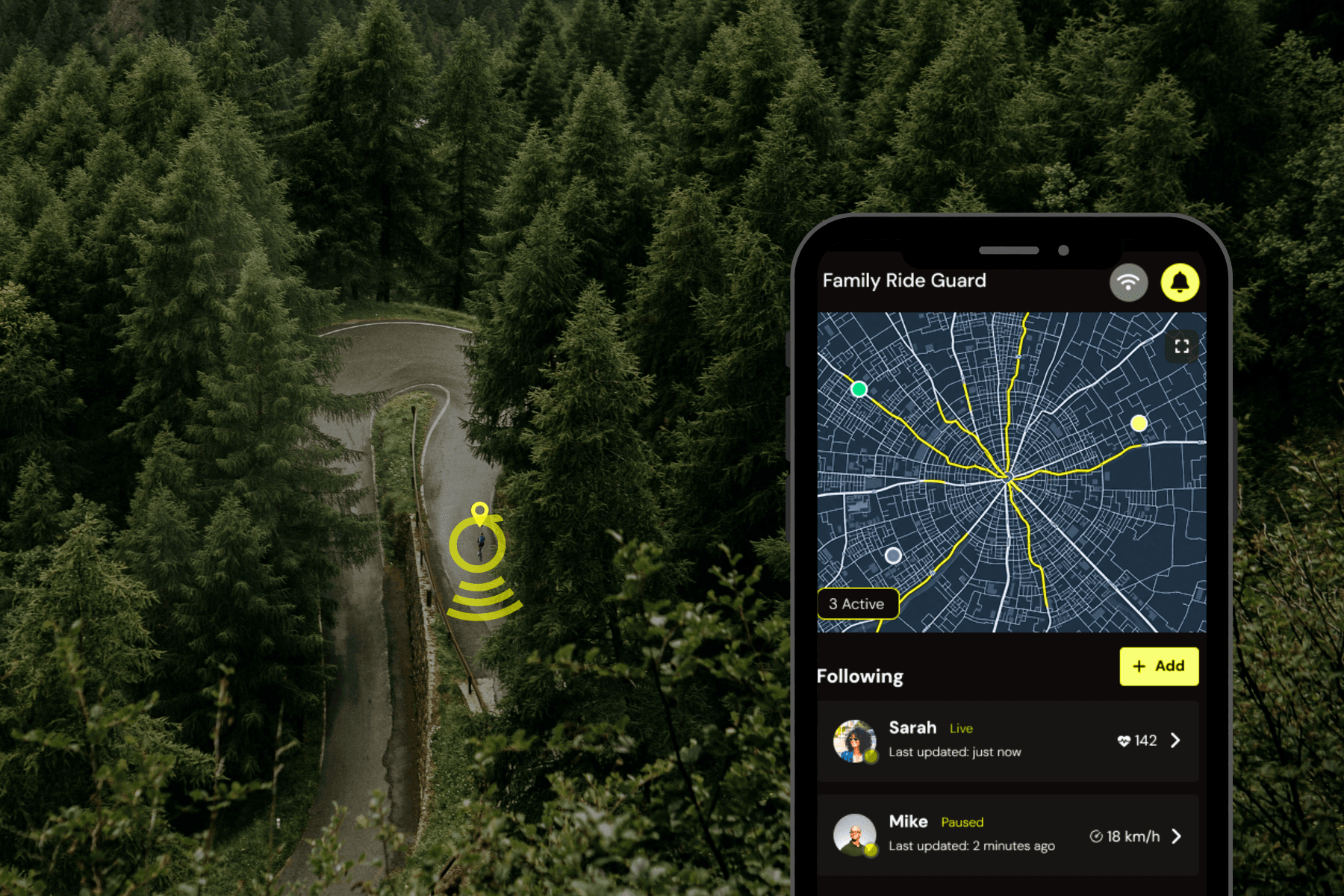
The upgrade: A free cycling safety app like My Bike Guard takes this further with Family Ride Guard — live location sharing that works automatically from the moment you set off. Your chosen contacts receive a notification when your ride starts, so they know you're out without you needing to text anyone. They can then follow your position in real time throughout the ride. If you stop moving unexpectedly, they'll see it immediately.
Plan Your Route With Safety in Mind — Not Just Scenery
Most cyclists plan routes to find the best climbs or avoid traffic. For solo riding, your planning needs one extra layer:
- Signal coverage. If you're heading into a rural or hilly area with patchy signal, download your map offline beforehand. Komoot and Ride with GPS both allow this. Running out of navigation data 40km from home is more than inconvenient.
- Road surface. Unfamiliar descents at speed are a different risk when you're alone. If you don't know what's under your tyres, back off.
- Traffic timing. The same road that's quiet at 7am on a Sunday can feel like a fast arterial road on a Tuesday evening. If you're trying a new route on a weekday, check when the traffic peaks.
- An exit plan. On rides over 2 hours, know where the nearest towns or villages are. If something goes wrong mechanically or physically, your options change completely depending on whether you're 3km from a village or 20km from anywhere.
None of this is about obsessing over every detail before you leave. It's simply about having a rough mental map of where you're going and what your options are. Five minutes of route awareness before you head out is worth an hour of uncertainty if something goes wrong.
The 60-Second Bike Check You Should Never Skip
When you ride with others, the group is a safety net — someone will spot the slow puncture you missed, mention the brake rub, notice the loose quick release. Alone, that net disappears entirely.
Before every solo ride, spend 60 seconds on this:
- Tyres: Squeeze both — do they feel firm? Run your fingers around the tread and look for anything embedded.
- Brakes: Squeeze both levers — do they engage firmly well before touching the bars?
- Wheels: Are the quick releases or thru-axles fully secured?
- Chain: Spin the cranks — does it move smoothly, or is there skipping or grinding?
That's it. 60 seconds. The number of solo rides that have ended in a long roadside wait because of something that would have been obvious in a pre-ride check is significant. Don't be that rider.
Your Phone Is Your Lifeline — Treat It Like One
On a solo ride, your phone handles navigation, emergency calls, location sharing, and — if you're using a free cycling app like My Bike Guard — real-time radar alerts. That's a lot to ask of a battery that started the morning at 80% because you forgot to charge it overnight.
Two habits that cost nothing:
- Charge your phone fully before every ride. Not 73%. Full.
- Carry a small power bank on longer rides. A 10,000mAh bank (roughly the size of a thick chocolate bar) fits in a jersey pocket and can fully recharge your phone mid-ride. On a 4-hour solo ride in summer, you will use more battery than you expect.
One extra step worth taking: make sure your emergency contact is saved as a favourite, and that Face ID or fingerprint unlock is active. If you're dazed after a fall and trying to make a call, fumbling through contacts with shaking hands is not the moment to discover your phone requires a PIN.
On the Road: Where Most Accidents Actually Happen
The Rear-End Risk That Doesn't Get Talked About Enough
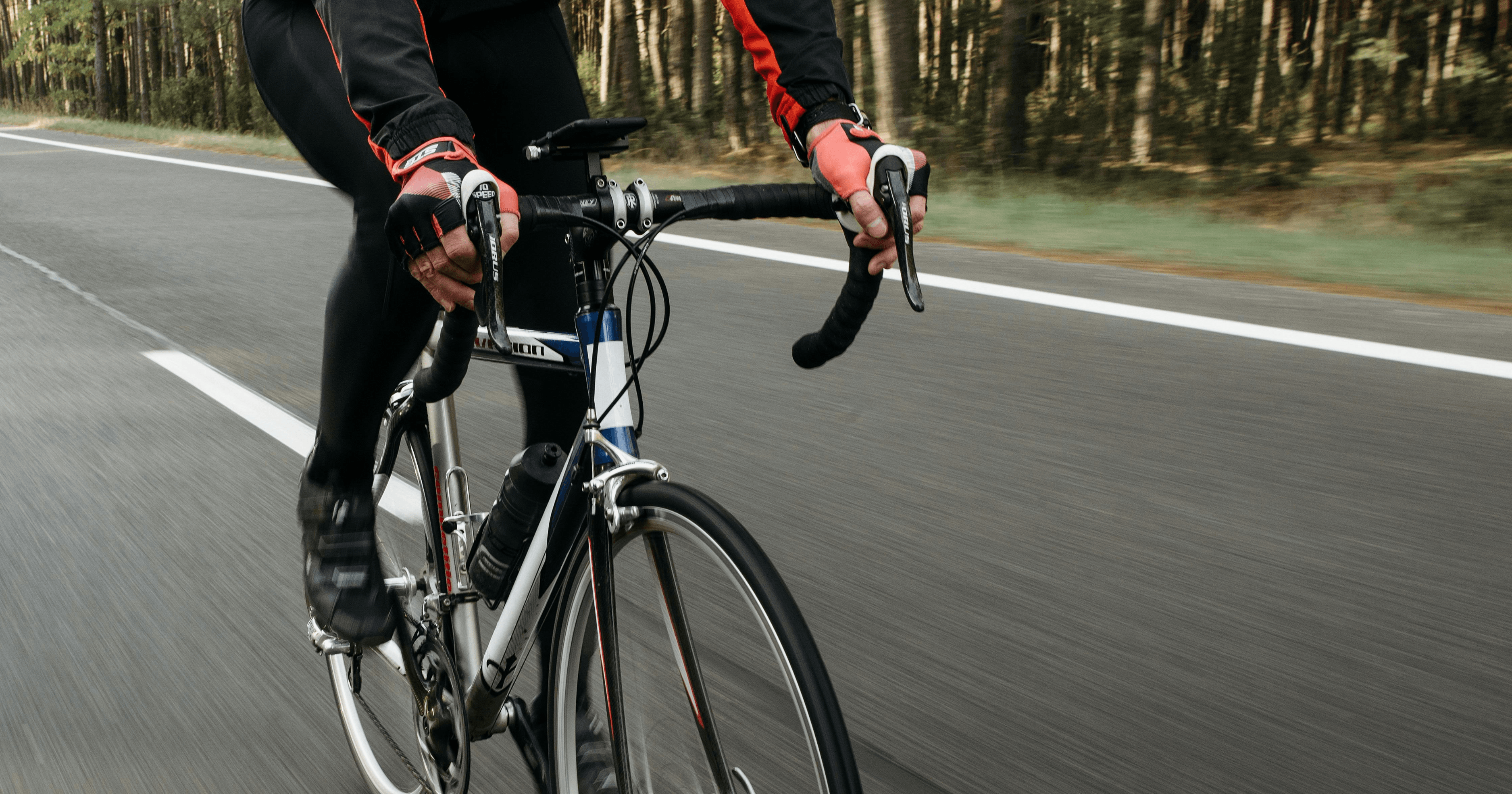
According to a 2026 report by the European Transport Safety Council (ETSC), 1,926 cyclists were killed on EU roads in 2024 — and 65% of those deaths resulted from collisions with motor vehicles. For road and gravel cyclists riding on open rural roads, the threat from behind is particularly significant: cars travelling at speed on country roads have less time to react, and a solo cyclist is far less visible than a group spread across the lane.
The core problem is reaction time. By the time you hear a fast-approaching vehicle on an open road, you may have one or two seconds to respond. Radar devices like the Garmin Varia detect approaching vehicles up to 140 metres behind you, giving you several seconds of advance warning. If you already ride with a radar, the question is what you're doing with that data. My Bike Guard — a free cycling safety app — displays real-time approaching vehicle alerts directly and clearly on your phone screen, so the warning is impossible to ignore when it matters most.
Ride More Conservatively Than You Would in a Group
This is the piece of advice that experienced solo cyclists consistently give and that almost never appears in safety guides.
In a group, collective confidence is contagious. You descend faster because others are descending fast. You push through fatigue because the bunch is moving. You take a corner with more commitment because you've been following a wheel confidently for two hours. None of that exists when you're alone.
Practical rules for solo riding:
- On descents you don't know well, consciously back off 10–15% from your usual pace
- On wet or damp roads, your stopping distance roughly doubles — leave more space than feels necessary
- If you're genuinely tired — not just uncomfortable, but actually impaired — consider cutting the route short. Fatigue is one of the most underreported contributing factors in solo cycling crashes
That last one is harder than it sounds. Nobody wants to admit the ride beat them. But the risk calculation is different when you're alone.
Visibility: The Dawn and Dusk Problem
Summer cycling means early starts and long evenings — which sounds ideal, until you consider what low sun angle does to driver visibility. A driver heading east into a rising sun, or west into a setting one, can have their vision almost completely obliterated. You can be in full hi-vis kit on a clear road and effectively invisible to them.
In these conditions:
- Run a rear light on flash mode even in full daylight
- Choose routes that avoid west-facing roads in the evening hours if possible
- Be especially cautious at junctions and roundabouts where drivers are turning into the sun
This is a risk that most cycling safety guides don't mention specifically. It's also one of the most preventable.
What To Do When a Car Passes Too Close
Close passes are among the most common and unsettling experiences in solo road cycling. Your instinct in the moment is often to swerve away — but this is frequently more dangerous than holding your line, and can cause you to hit the car or lose control of the bike.
If a vehicle passes dangerously close:
- Hold your line — a sudden swerve is more dangerous than the pass itself in most cases
- Don't gesture or shout immediately — your attention needs to stay on the road
- Note the registration if you can — in many European countries, close passes can be reported to police, particularly with camera evidence
- Give yourself 60 seconds — the adrenaline spike after a close pass genuinely affects your judgment and reaction time. If you need to pull over briefly to settle, do it
If Something Goes Wrong
The First 60 Seconds After a Crash
Most cycling safety content tells you how to avoid crashes. Very little covers what to actually do in the moments after one, when you're alone.
- Don't move immediately. Take 10–15 seconds to assess before trying to get up. Moving too quickly after a crash where you've hit your head or landed awkwardly can make an injury worse.
- Get off the road. If you can move, get to the verge or pavement. Being hit by a second vehicle while recovering from a crash is a real risk on fast roads.
- Assess for serious injury. Road rash looks dramatic but is usually minor. The things to watch for: head impact (even with a helmet), inability to bear weight on a limb, chest pain, or anything that feels wrong in a way that's hard to describe.
- Use your location. If you're using My Bike Guard, your contacts already know where you are. If not, open your maps app — your exact coordinates are there even without signal, and you can relay them to emergency services.
The Three Mechanicals Worth Being Prepared For
- Puncture: The most common. If you carry a spare tube, tyre levers, and a CO2 inflator or mini pump, a puncture is a 10-minute roadside fix. The catch: if you've never practised changing a tube, the first time you do it alone at the side of a road is not ideal. Do it once in your living room first.
- Broken chain: Less common but ride-ending without the right kit. A chain tool and a spare quick link weigh almost nothing and fit in any saddle bag. If you've never broken a chain on a solo ride 25km from home, you may not think this matters. Ask someone who has.
- A flat you genuinely can't fix — sidewall blowout, no spare left, sealant that won't hold: know the nearest town before you leave, have a taxi app on your phone, and know your battery level. These decisions are much easier to make at home than at the side of a road in the rain
The Mindset Shift That Changes Everything
The cyclists who ride solo with genuine confidence aren't braver than those who don't. They're better prepared — and that preparation removes most of the mental overhead that makes solo riding feel risky.
When you know your phone is charged, someone knows your route and when to expect you back, your bike is in good condition, your location is being shared automatically, and you have the kit to handle the most common mechanicals — the ride itself becomes what it's supposed to be. Freedom. Focus. Yours.
Solo riding is one of the best things about cycling. It just asks for a slightly different level of self-reliance than riding with others. Build the habits, use the right free cycling safety app, and the road is yours.
Frequently Asked Questions About Solo Cycling Safety
Is it safe to cycle alone?
Yes — solo cycling is safe when approached with the right preparation. The main risks are reduced visibility to others, no one to assist if something goes wrong, and the absence of a group to spot mechanical issues. These risks are all manageable with good habits: sharing your route, using a cycling safety app with live location sharing, carrying basic repair kit, and riding within your limits.
What is the best free cycling safety app for solo riders?
My Bike Guard is a free cycling safety app designed specifically for this. It integrates with existing radar devices like the Garmin Varia, displays real-time approaching vehicle alerts on your phone screen, and includes Family Ride Guard — a live location sharing feature that automatically notifies your trusted contacts when you set off and lets them follow your ride in real time. There's no subscription and no extra hardware required beyond the radar you may already own.
How do I share my location while cycling?
The simplest way is to use a cycling safety app with built-in location sharing. My Bike Guard's Family Ride Guard feature does this automatically once set up — your chosen contacts receive a notification when you start your ride and can see your live position throughout, without you needing to send any updates. Alternatives include WhatsApp Live Location (manual, time-limited) or Strava Beacon (requires a subscription).
What should I carry on a solo cycling ride?
At minimum: a spare tube, tyre levers, CO2 inflator or mini pump, a multi-tool with chain breaker, a spare quick link, a fully charged phone, and a small power bank on longer rides. Some riders also carry a basic first aid kit and a bank card for emergencies.
What do I do if I crash while cycling alone?
Don't move immediately — assess for serious injury first. Get off the road if you can. Check for head impact, inability to bear weight, or chest pain. Call for help if needed, and use your phone's map or a cycling safety app to share your exact location with emergency contacts or services.
How can my family track me while I'm cycling?
Apps like My Bike Guard include live location-sharing features built for exactly this. Once set up, your chosen contacts receive a notification when your ride starts and can follow your position in real time. If you stop moving unexpectedly, they'll be able to see it immediately — without any action needed from you mid-ride.
My Bike Guard is a free cycling safety app for road and gravel cyclists. It integrates with your existing radar, shares your live location with trusted contacts via Family Ride Guard, and delivers real-time car alerts directly to your phone screen. No subscription. No extra hardware. Just safer solo rides. Download free here.